
Choosing the Right Adhesive
A straightforward guide to choosing the optimum adhesive for the installation of floorcoverings from the UK’s leading manufacturer of subfloor preparation products and adhesives for flooring, F. Ball and Co. Ltd., including checking the compatibility of chosen floorcoverings and adhesives.
The drive to help flooring contractors work to ever higher standards, with greater speed and efficiency, as well as increase the longevity of flooring installations, has led to the development of high performance adhesives for a range of floorcoverings with a range of specialist properties.
For this reason, when it comes to selecting an adhesive for a specific installation, it is always advisable to consider products that have been developed for particular applications and types of floorcoverings.
Adhesive selection should be based on the details of an individual flooring installation, including the properties required for ease of installation and the conditions to which the adhesive will be exposed. It is always advisable that contractors check the compatibility of adhesives and particular floorcoverings to ensure against floor failure.
Textile floorcoverings
When installing carpet over large areas that will be subject to heavy use, such as hotel corridors and events venues, contractors will typically require an adhesive that will develop a high bond strength to hold floorcoverings firmly in place over the lifetime of an installation. However, carpet and underlay installed with this kind of adhesive will require mechanical removal when they need replacing.
For this reason, dual-bond systems have been developed, utilising adhesives that dry to form a transparent, permanently tacky coating to prevent underlay moving laterally when subject to normal foot traffic but allow them to be easily lifted without damaging the subfloor.
The type of bond achieved when using F. Ball and Co. Ltd.’s Styccobond F40, for example, depends on when the floorcovering is laid into the adhesive. Laying the floorcovering into the wet adhesive gives a permanent bond. However, the water-based adhesive dries to form a transparent, permanently tacky coating, creating a release bond for underlays.
This can form part of a dual-bond system, where flooring contractors install underlay onto the tacky coating before adhering carpet to the underlay using a specialist adhesive for textile floorcoverings, such as F. Ball’s Styccobond F3, which will develop the high bond strength required to withstand expected levels of wear.
Other floorcoverings
Flooring contractors installing vinyl floorcoverings face a potentially confusing array of adhesives to choose from. Standard, wet-lay adhesives are available for installing almost any type of vinyl sheet or tile floorcovering. The contractor simply applies the adhesive evenly over the subfloor using a trowel and allows it to paste slightly before placing the floorcoverings and rolling to ensure good overall contact. This category includes F. Ball’s Styccobond F44 solvent free acrylic emulsion adhesive, which offers high bond strength, strong initial grab and a long open time.
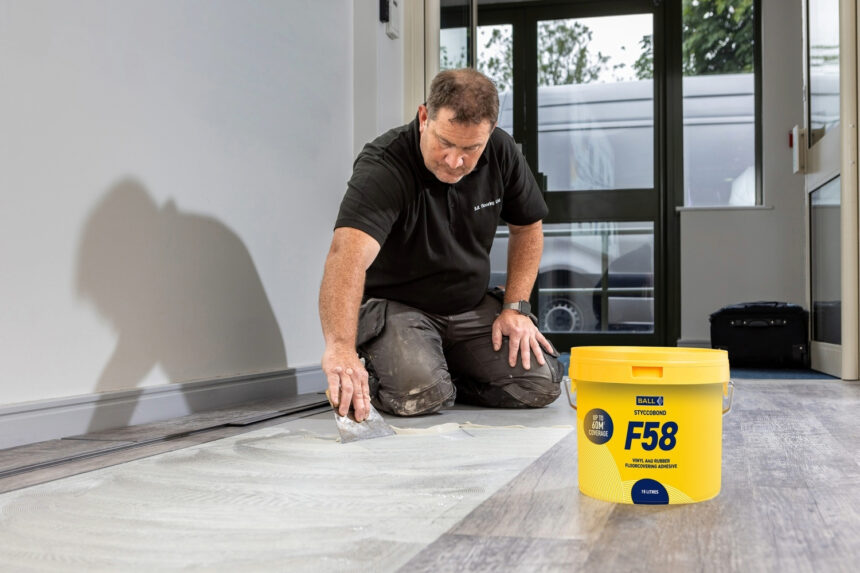
While wet-lay adhesives are fine where an immediate bond is not required, adhesives with pressure sensitive characteristics are often the best choice for installing vinyl tiles or planks. They form an instant grab upon contact, so contractors don’t need to worry about tiles or planks moving about when they are working, making them ideal for where intricate designs or patterns are being created. These include F. Ball’s Styccobond F58, a solvent-free adhesive that can be used as a wet lay, semi-wet or pressure sensitive adhesive for securing PVC vinyl sheet and tile floorcoverings.
When used as a wet lay adhesive, F. Ball’s Styccobond F58 can also be used to install rubber sheet and tile floorcoverings up to 4mm thick.
Hybrid adhesive technology has enabled the development of pressure sensitive adhesives with a range of additional features, such as F. Ball’s Styccobond F49 Hybrid PS, which has some moisture tolerance characteristics, making it suitable for installing LVTs in damp and humid environments. The water-based adhesive also develops the extremely high bond strength to hold floorcoverings in place in areas exposed to extreme temperature fluctuations (from -20°C to +60°C).
Compatibility check
It is always recommended that contractors check the compatibility of particular adhesives and floorcoverings as part of any flooring installation. For this purpose, F. Ball produces its industry-leading Recommended Adhesives Guide (RAG®), which provides over 6,000 adhesive recommendations for floorcoverings produced by over 200 manufacturers.
Recommendations are included in the guide only after the completion of a rigorous 56-day testing programme at F. Ball’s state-of-the-art testing facilities and subject to positive endorsement by the relevant floorcovering manufacturer. This makes the F. Ball RAG® the most trusted and comprehensive guide to floorcovering-adhesive compatibility available.
So confident is F. Ball in the recommendations featured in the RAG® that it guarantees the resulting bond performance for the entire lifetime of the flooring installation, as long as the advised subfloor preparation and installation procedures are followed.
A constantly updated version is available on the F. Ball website and as a mobile app, which is free to download. Alternatively, F. Ball’s head office-based technical service department are on hand to answer your questions about F. Ball products and how to use them. Contractors can also consult floorcovering manufacturers for advice.