

Flooring Failure Fix
F. Ball and Co. Ltd. is the UK’s leading manufacturer of subfloor preparation products and adhesives for floorcoverings. Its Technical Service Team provides expert advice on the best course of action for particular flooring projects when using its products. Here, the company’s Technical Service Manager, Jason Tatton, shares a real-life example of a fix for a flooring failure resulting from an improper moisture management solution.
An F. Ball technical representative recently supported a flooring contractor who had been called to a residential property more than a century old, where timber flooring that had been installed in a ground floor extension had begun to warp and lift – it looked like waves on the sea.
Damp seemed the obvious cause – it’s still the leading cause of floor failure. Prior to the installation of a wood floorcovering the Relative Humidity of the subfloor must be tested for moisture content ensuring the reading is below 75% in accordance with ASTM F2170 insitu probe method. Where subfloor relative humidity levels are above 75%, a moisture management solution is absolutely essential to stop moisture attacking floorcoverings and adhesives.
Closer inspection
To be sure, they lifted some of the timber planks to inspect the subfloor. The builder who had undertaken the preparation work had applied a waterproof surface membrane over the newly installed concrete screed, followed by a thin layer of smoothing compound to create a smooth base for floorcoverings. The age of the property meant that there would have been no legal requirement for a damp-proof course to be installed when it was built.
So the problem couldn’t be damp? Well, the tech rep suspected that the solution in place was actually a bitumen damp-proof membrane. When they contacted the builder to check, this was confirmed.
The issue
The problem is that these types of products are sandwich membranes, which unlike epoxy/resin systems, such as F. Ball’s Stopgap F77, or water-based types, such as Stopgap F78 (F78 is flexible when cured), don’t form a rigid film when cured. Instead they remain soft and flexible. This isn’t an issue if a thick, structural screed is applied over the top. However, if a thin layer of smoothing compound is applied, the stresses that the bitumen damp-proof membrane (DPM) will be subject to can cause it to separate, compromising its integrity and allowing subfloor moisture to migrate to the level of floorcoverings and cause problems.
The solution
In this situation, there was no other option but to lift all of the timber floorcoverings and mechanically remove the previously installed smoothing compound and bitumen DPM.
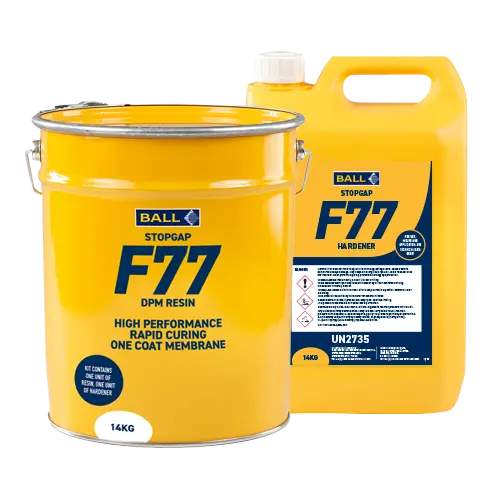
Following this, they applied F. Ball’s Stopgap F77, which creates a barrier against excess subfloor moisture where subfloor relative humidity levels are up to 98% with a single coat application.
Once the membrane had cured, the surface was primed using Stopgap P141, which is specially formulated to enhance the bond performance between non-absorbent surfaces, including waterproof surface membranes, and subsequently applied subfloor preparation products. It contains recycled uPVC pulver to create a textured finish, which helps adhesion.
Contractors could then apply a smoothing compound, such as F. Ball’s Stopgap Red Bag, to create the perfect base for the new wood floorcoverings.
Full circle
Finally, it was recommended to use a suitable flexible wood adhesive, such as F. Ball’s Styccobond B96, to install new wooden blocks in a herringbone pattern. The single-part, moisture-curing adhesive will accommodate the natural movement of wood throughout the lifetime of the installation. It also offers good initial grab, useful for creating the parquet design.
Using these products in this order will ensure a long-lasting professional flooring finish, with no risk of floor failure as the result of excess subfloor moisture this time.