

Optimum Results, Guaranteed
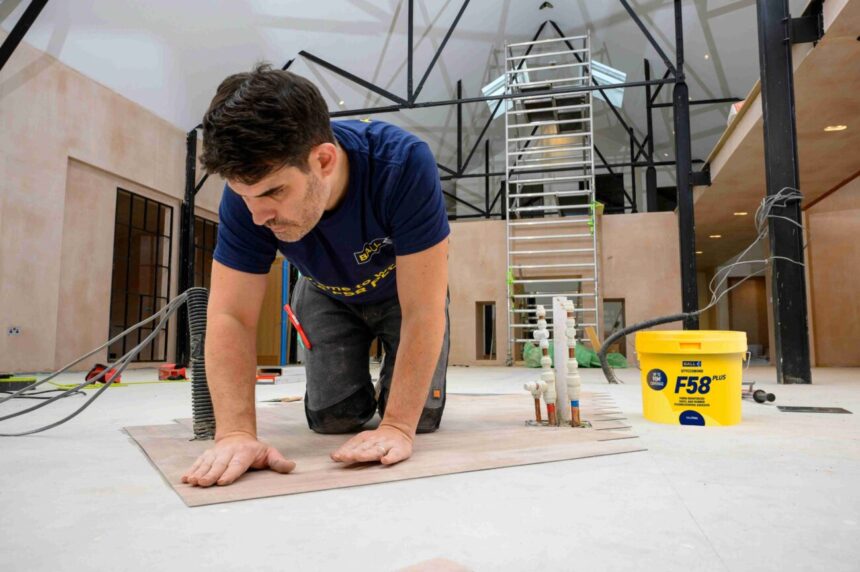
Given the premium associated with LVTs and customers’ high expectations for finished results, it is important to know about steps to follow and floor preparation products and adhesives to use to ensure a flawless finish when installing them.
For this reason, F. Ball and Co. Ltd. developed its ‘System LVT’ range, which comprises waterproof surface membranes, primers and smoothing compounds that, used correctly and in combination, will guarantee an aesthetically pleasing, durable floor finish for LVT installations.
It means that flooring contractors can enjoy the peace of mind that comes with knowing that their products will perform for the entire lifetime of a flooring installation, as long as the advised subfloor preparation and installation procedures are followed.
First Steps to a Flooring Installation
Before beginning any flooring installation, a flooring contractor should check that the subfloor is suitably sound, smooth and dry. Any laitance and other surface contaminants should be mechanically removed.
At this stage, a moisture test should be conducted to determine if the subfloor is dry enough to receive floorcoverings. Excess subfloor moisture, whether residual construction moisture or rising damp, is the leading cause of floor failure, resulting in costly recalls and delays.
Guarding Against Damp
Where subfloor Relative Humidity (RH) levels are higher than 75%, a moisture management solution will be required to prevent moisture attacking flooring adhesives and causing resilient floorcoverings to blister and lift.
F. Ball’s System LVT range includes both of the company’s high-performance waterproof surface membranes. An epoxy formulation is available that will isolate excess subfloor moisture where RH values are up to 98%, with a single coat application, which will fully cure in as little as three hours.
A water-based solution, Stopgap F78 will create an effective barrier against residual construction moisture where relative humidity values are up to 95%, with two coats. The first coat cures in 15-20 minutes. A further 30 minutes curing time is required for the second coat. When using Stopgap F78, there is no need to prime the surface prior to the application of other subfloor preparation products, saving further time.
Priming the Subfloor
It will be necessary to prime the subfloor in most situations. When used over non-absorbent surfaces, such as waterproof surface membranes, primers promote adhesion between the subfloor and the smoothing compound applied over it. Applied over absorbent subfloors, they also stop the unacceptably rapid drying of smoothing compounds.
Priming also prevents ‘pinholing’. These are small holes in the smoothing compound that have the appearance of pinholes or blisters caused by the slow escape of air from absorbent surfaces as the smoothing compound cures.
General-purpose primers are available that can be used over both absorbent and non-absorbent surfaces. There are also specialist primers for use over non-absorbent surfaces and ones for calcium sulphate screeds.
Creating a Base
A smoothing compound should then be applied over the subfloor to create a perfectly smooth and level surface onto for the LVT installations. This ensures that the visual appearance of the floorcovering is flawless and not compromised by imperfections in the subfloor showing through the LVT.
While formulations with specialist features are often advantageous, or even highly recommended, general-purpose options, such as F. Ball’s recently launched Stopgap 1400, are suitable for many situations.
In heavy-duty areas, where LVT installations will be subject to heavy loads or high foot traffic, the use of a heavy-duty smoothing compound is recommended.
When working over subfloors of plywood or steel, the application of a flexible smoothing compound that is able to accommodate slight movements in the subfloor is advised.
Where an LVT installation is part of a refurbishment and old adhesive residues are present after the removal of old floorcoverings, flooring contractors can save time by selecting a smoothing compound that can be applied over old adhesive residues, without the need to prime beforehand. Normally adhesive residues need to be fully removed before applying a smoothing compound.
Adhesive Selection
Pressure sensitive adhesives, such as Styccobond F46, are often the best choice for installing vinyl tiles or planks. They form an instant grab upon contact, so contractors don’t need to worry about tiles or planks moving about when they are working, making them ideal for where intricate designs or patterns are being created.
It will often be desirable to have the advantages of other kinds of adhesives for LVT installations. In addition to Styccobond F46, F. Ball’s ‘System LVT’ range features pressure sensitive adhesives for vinyl floorcoverings that combine a variety of other specialist attributes, including the ability to hold vinyl floorcoverings firmly in place in areas exposed to extreme temperature fluctuations (from -20°C to +60°C).
Flooring Compatibility Check
Finally, it is highly recommended that contractors always check the compatibility of particular floorcoverings and adhesives. To do this, you can consult the floorcovering manufacturer’s guidelines. Alternatively, F. Ball produces a Recommended Adhesives Guide (RAG®), which lists adhesives recommended for use with over 6,000 floorcoverings produced by over 200 manufacturers. The guide is available as a free app or a printed booklet. An interactive version can also be found on the F. Ball website. Alternatively, contractors can contact F. Ball’s technical service department, from 8.30am–5.00pm, Monday to Friday, for advice on adhesive compatibility.
Find out more about F. Ball’s System LVT range here: https://f-ball.com/en/product-category/system-lvt/.