

Base Words: Smoothing Compounds, Levelling Compounds and Screeds
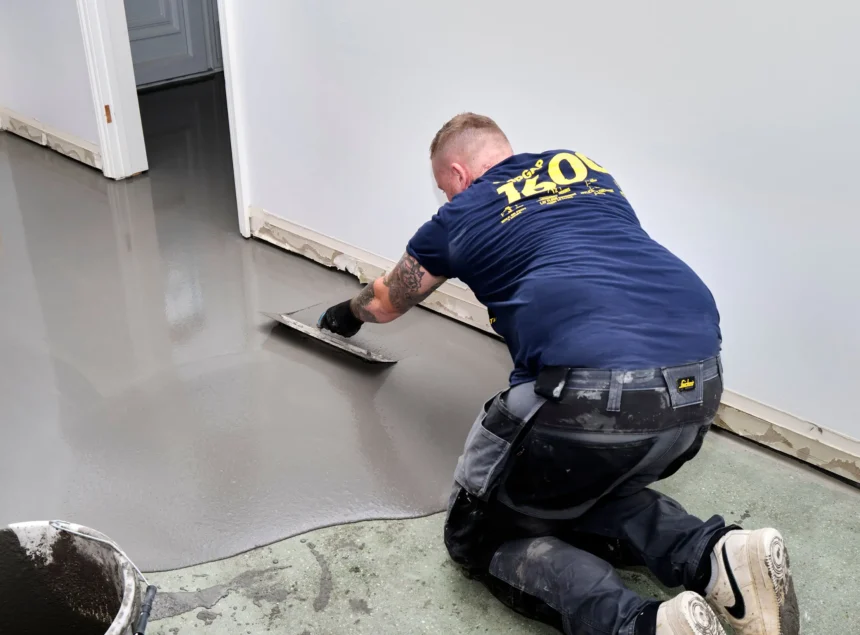
Working in the flooring industry, it is common to hear professionals casually use the terms ‘smoothing compound’, ‘levelling compound’ and ‘screed’ interchangeably, while they strictly mean different things. While this doesn’t necessarily cause issues, it is important to be aware of differences in vocabulary to avoid confusion when talking about subfloor preparation that could result in failure to ensure a long-lasting, aesthetic flooring installation.
For the avoidance of doubt, here is a brief explainer on what the different terms mean and how they are used.
Screeds: a structural base
At the foundation of many floor constructions, a screed is a cementitious material, typically a mixture of cement, aggregate and water. Its primary role is to provide a solid, robust, and relatively even structural layer on to which subsequent flooring layers can be installed. While a screed aims for a reasonable level of evenness, it is not usually perfectly smooth or level. There are different types of screed, including traditional sand/cement or concrete screeds, flowing anhydrite screeds, and quick-drying screeds, each with their own optimal applications.
It is common for people to say ‘screed’ when referring to a smoothing or levelling compound, while they are not the same.
Levelling compounds: addressing height difference
A levelling compound or self-levelling compound is an aggregate rich flowing, cement or gypsum-based material designed to address discrepancies in height and more significant undulations across a subfloor. Application thickness for levelling compounds ranges from a few millimetres up to around 70-80mm in a single pour, depending on the product and the extent of the unevenness.
‘Self-levelling’ means that the product spreads out and finds its own level by itself as a result of gravity.
It is worth noting that ‘smoothing compounds‘ are often referred to as ‘levelling compounds’, including by some manufacturers, even when they don’t necessarily create a level surface.
Smoothing compounds: eliminating subfloor imperfections
Finally, a smoothing compound is applied to create a perfectly smooth surface to prevent any subfloor imperfections showing through floorcoverings and affecting the appearance of the finished installation. This is particularly important when installing thin resilient floorcoverings, such as vinyl and linoleum sheet and LVTs (Luxury Vinyl Tiles). Smoothing compounds also help with adhesive application, providing an ideal surface for the adhesive to key into to optimise its bond strength and hold the floorcovering firmly in place.
While general-purpose smoothing compounds are available, there are also situations when it is advantageous, or even highly recommended, to use a smoothing compound with specialist features. This includes in heavy-duty environments or when installing wood floorcoverings, where a heavy-duty smoothing compound, such as Stopgap 300, is recommended to withstand the extra stresses and strain to which it will be subjected. When working over calcium sulphate screeds, the application of a calcium sulphate-based smoothing compound is advisable. A smoothing compound that can accommodate subfloor movements, such as F. Ball’s Stopgap 700, will be required when working over flexible subfloors.
Subfloor synonyms: smoothing underlayments
Another term that the flooring industry has adopted to refer to smoothing compounds that it is useful to be aware of is ‘smoothing underlayment’.
To be clear: both terms describe the same category of products applied to a subfloor to create a perfectly smooth surface for the receipt of new floorcoverings.
Need expert advice?
F. Ball’s Technical Service Department are on hand to advise on all aspects of subfloor preparation and floorcovering installation, including smoothing compound selection, from Monday to Friday, 8.30am to 5pm.