


Sticky situations
In Sticky Situations, F. Ball technical representatives provide solutions to tricky flooring conundrums they encounter on site visits. In this issue, Steve Lane provides a specification for overcoming subfloor preparation challenges.
When dealing with ground-floor refurbishments in older buildings, old floorcoverings often conceal underlying issues that must be addressed to ensure the longevity of the new installation.
This was the case when we were recently asked to take subfloor moisture readings and advise on subfloor preparation ahead of the installation of luxury vinyl tiles (LVTs) in a 110m² function room with a concrete base.
Assessment
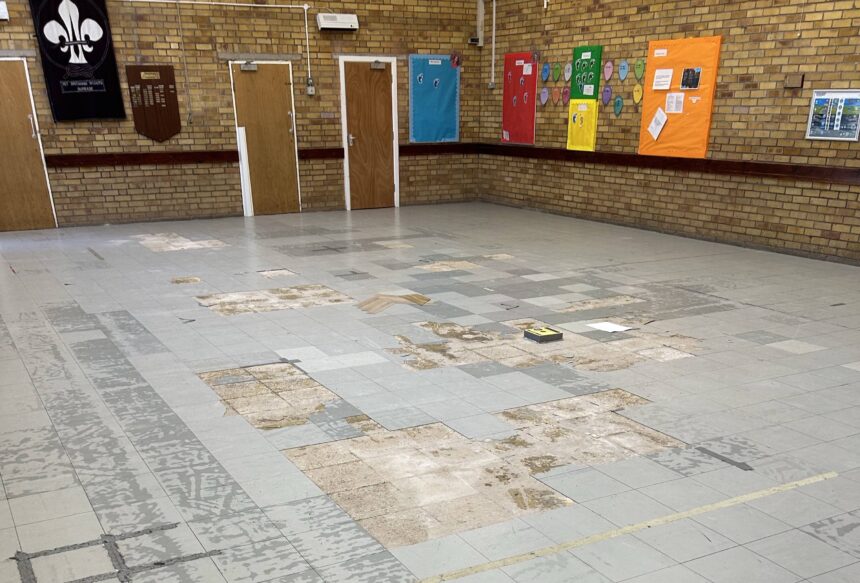
Upon inspection, it was found that old, ‘crunchy’ vinyl tiles were still in place. Indicative moisture tests revealed that subfloors were ‘at risk’ of excess subfloor moisture. The subfloor was also rough and uneven in areas.
Further testing with a digital hygrometer confirmed the moisture concern, giving a reading of 89% relative humidity (RH). In accordance with BS 8203 (Code of practice for installation of resilient floorcoverings), floorcoverings should not be installed where a moisture test gives a reading of more than 75% RH unless a moisture management solution is in place to avoid the possibility of floor failure.
Recommendations
The first thing for the contractor to do was to lift the existing vinyl tiles and mechanically remove old adhesive residues and smoothing compound to obtain a sound, clean, and dust-free concrete surface, ensuring that subsequent preparation products can bond effectively to the base.
It was advised that a liquid waterproof surface membrane should be used to control moisture levels. This requires a reasonably smooth and flat surface to ensure a continuous barrier without necessitating extra quantity of the product and prolonging drying times, so it was recommended that any significant irregularities be addressed prior to its application.
This was achieved by priming with F. Ball’s Stopgap P131 primer, diluted with seven parts water, and allowing the primer to dry before applying a minimum 3mm skim of Stopgap 1200 smoothing compound where the base was insufficiently smooth. The product was recommended for its moisture resistant properties, meaning it could be applied before a moisture management solution without being affected by excess subfloor moisture.
A single coat of Stopgap F77 solvent-free epoxy damp proof membrane was applied using a 1.5mm x 5mm V-notched trowel. A roller, pre-coated with the product, must then be used to achieve a continuous, pinhole-free finish. Once the waterproof surface membrane had cured, it could be primed with Stopgap P141 primer and allowed to dry before applying a minimum 3mm skim of Stopgap 1400 smoothing underlayment to conclude preparations to create a smooth base for floorcoverings.
Adhesive selection
Finally, it was recommended that the LVTs were installed using Styccobond F49 Hybrid PS. This temperature-tolerant, pressure-sensitive adhesive is specifically designed to withstand extreme temperature changes, ensuring the floorcoverings remain firmly in place despite environmental variations. As always, contractors are advised to consult the Recommended Adhesives Guide (RAG®) to confirm compatibility with the specific brand of vinyl being installed.
Steve Lane is F. Ball technical representative for the East Midlands.
F. Ball’s regional technical representatives provide advice to flooring contractors on how to get the most out of F. Ball products, including conducting site visits and producing case-specific reports advising on the best course of action for particular flooring projects. Find out who your technical representative is here.