

Addressing Subfloor Imperfections
Ensuring a perfectly smooth base for the receipt of new floorcoverings is one of the first steps in any flooring installation. This will typically be achieved with the application of a smoothing compound. In some cases, it will also be necessary to first address imperfections in the subfloor beforehand to ensure a perfect finish. This is particularly important when installing thin, resilient floorcoverings. Jason Tatton, Technical Service Manager at F. Ball and Co. Ltd., advises on repair and finishing compound selection for this purpose.
Contractors should begin any flooring installation by ensuring the subfloor is suitably sound, smooth and dry enough for the receipt of new floorcoverings. As part of this, F. Ball recommends the application of a smoothing compound to achieve a smooth base. However, there will be occasions where prior preparation is required; where sand/cement screeds are mechanically damaged or ceramic tiles are missing, for example. Repair compounds are available for these situations.
Before any remedial work takes place, it is advisable to undertake a moisture test to determine subfloor moisture levels. Where subfloor Relative Humidity (RH) levels are above 75% (65% if wood floorcoverings will be installed), the application of a waterproof surface membrane will be required to prevent excess subfloor moisture potentially attacking adhesives and floorcoverings and resulting in floor failure. The requirement for a waterproof surface membrane will also have a bearing on repair compound selection and application.
Environmental considerations
In the case that a contractor finds that the subfloor has dormant/static, non-structural cracks or holes in it, which may be the case where sand/cement screeds have been mechanically damaged, a suitable repair compound should be used to fill in the gaps.
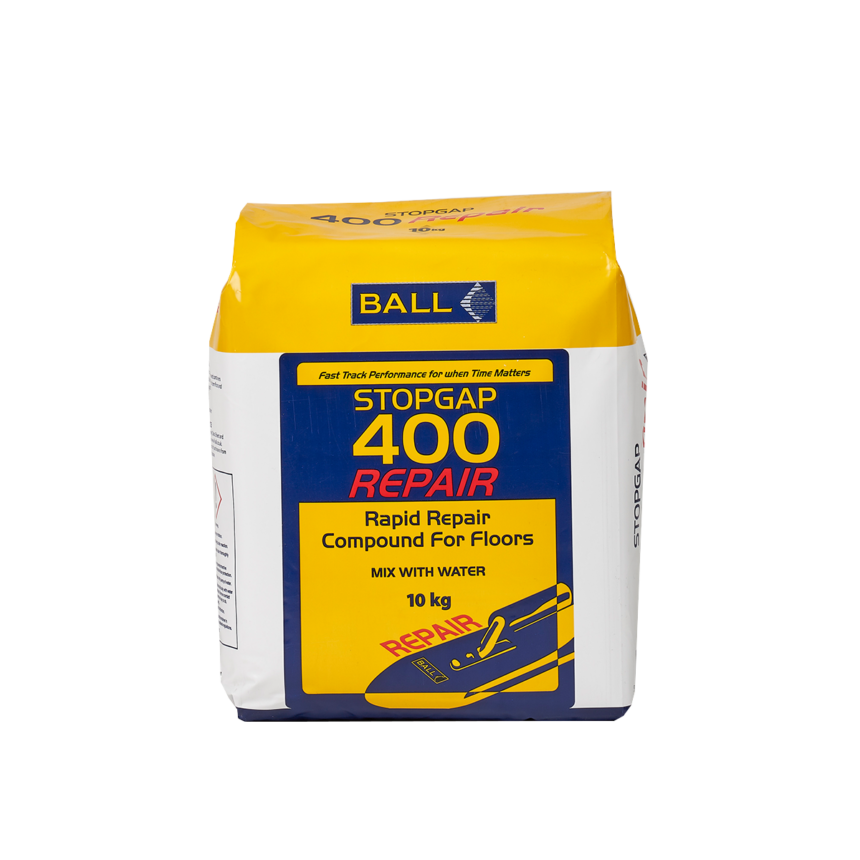
For example, F. Ball’s Stopgap 400 is a dry, fast-setting, rapid-drying repair compound that can be applied in thicknesses between 2-50mm to repair internal floors in light to heavy duty areas, including to fill gaps in tiled areas where individual ceramic tiles are missing.
Where excess subfloor moisture is detected, contractors will require a repair compound that is designed for use in damp conditions, prior to the application of a waterproof surface membrane. Some formulations of these products may be suitable for repairing external floors as part of refurbishment projects.
F. Ball’s Stopgap Micro Rapid ultra-smooth, flexible floor finishing compound can also be used as a scratch coat up to 1mm to repair minor surface defects in many absorbent surfaces, including smoothing compounds, as well as smoothing discrepancies between different applications of concrete or smoothing compound. Stopgap Micro Rapid should be used after smoothing compound has been applied.
Next steps
Once a repair compound or finishing compound used to fill imperfections in the subfloor has dried, contractors can then proceed with the application of a smoothing compound as recommended, remembering to prime the subfloor beforehand. Priming serves to promote adhesion and also maximises handling characteristics of smoothing compounds when applied over non-absorbent surfaces, such as ceramic tiles. When used over absorbent surfaces, primers also stop the unacceptably rapid drying of subsequently applied smoothing compounds and prevent pinholing: tiny bubbles formed by the slow escape of air from the subfloor, which burst on reaching the surface, leaving small pinholes as the smoothing compound cures.
Smoothing compound selection should be determined by the subfloor type and conditions to which the installation will be exposed. For example, heavy-duty smoothing compounds are available for areas that will be subject to heavy loads or high levels of foot traffic, and calcium sulphate-based smoothing compounds offer maximum compatibility with calcium sulphate screeds.
This article was first featured on the Tomorrow’s Contract Floors website. Visit their website to read more: https://www.tomorrowscontractfloors.co.uk