

The Knowledge: Underfloor Heating Installations
In this series, we tell you what you need to know to ensure flooring installations live up to high customer expectations.
The Knowledge has previously dealt with the technical aspects of each step in the flooring installation process, from subfloor preparation, including the application of a smoothing compound to create a perfectly smooth base for floor coverings, to selecting an appropriate adhesive.
We’ve also brought these elements together to advise on ensuring optimum results when installing particular types of floor covering and when areas are subject to certain environmental conditions, such as extreme temperatures and temperature fluctuations.
In this issue of F-Talk Retail, we’re covering things to consider when installing floorcoverings over underfloor heating installations that are increasingly common in domestic settings.
Common concerns
Flooring installations where underfloor heating is present are frequently a source of questions for installers, in particular ‘what smoothing compound should I apply to create a smooth base for floor coverings?’ and ‘what adhesives can I use?’.
All F. Ball smoothing compounds and adhesives are suitable for application over underfloor heating systems that are contained within a screeded subfloor. It is just recommended that systems are turned off 48 hours before the installation of floor coverings, during and 48 hours after.
The issue comes when working over retrofit electrical wired or water-fed underfloor heating systems that are increasingly installed over subfloors as part of new build or refurbishment projects. In these situations, it is advisable to allow between 5 – 35mm of a smoothing compound above the pipes (less for electrical wired systems), depending on the type of system being installed and the manufacturer’s instructions. It must be remembered that some systems are not designed to receive a smoothing compound but laminate flooring or ceramic tiles.
New development
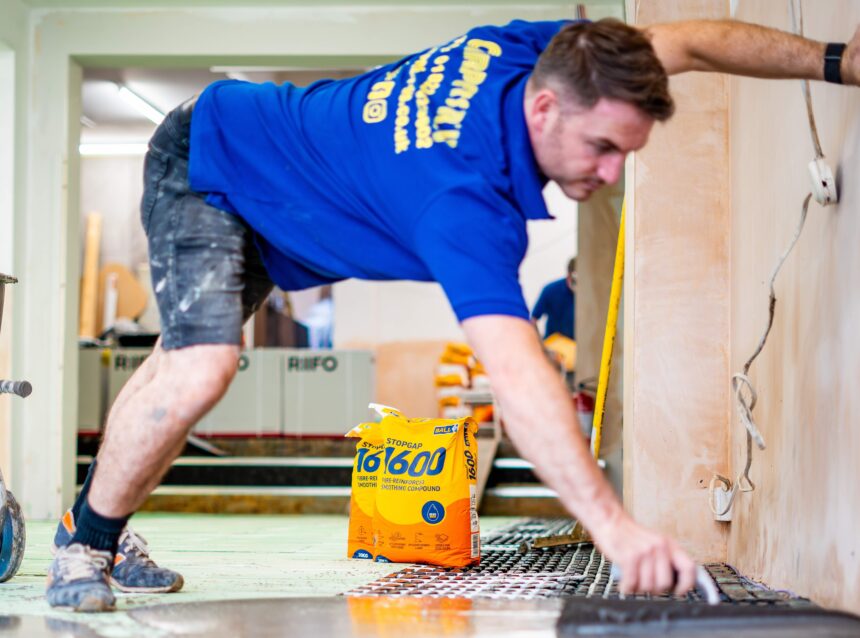
This has led F. Ball to launch Stopgap 1600, a new fast-drying, fibre-reinforced smoothing compound that is formulated especially to encapsulate underfloor heating systems.
It can be applied between 3 – 40mm thick installed over internal subfloors in both domestic and commercial environments, and is walk-on hard from three hours after application and ready to receive floor coverings in as little as 12 hours.
The product is suitable for use over a wide range of absorbent and non-absorbent subfloors, including sand/cement screed, tile backer boards, concrete, plywood, granolithic, terrazzo, epoxy and polyurethane resins, ceramic and quarry tiles, as well as Stopgap waterproof surface membranes.
Adhesive selection
The availability of temperature tolerant adhesives, for installing resilient floor coverings in areas where temperatures have the potential to rise significantly, raises questions about exactly when and where they need to be used. There is some confusion about why a temperature tolerant adhesive is required to install LVTs in conservatories, for example, but they are not necessary over underfloor heating.
As discussed in the last edition of The Knowledge, extreme temperatures or temperature fluctuations can cause vinyl floor coverings to expand and contract significantly. This is frequently the case in heavily glazed areas that are subject to solar gain during the day, such as conservatories, which then rapidly cool at night. Over time, this can lead to unsightly tenting and gapping at the edges of floor coverings, particularly between adjacent vinyl tiles or planks. When the bond has fully matured, temperature tolerant adhesives hold floor coverings firmly in place in these environments, restricting these movements and ensuring the long-lasting performance of installations.
Temperature changes
Temperature fluctuations as a result of underfloor heating systems are much more gradual and less extreme than changes in temperature resulting from solar gain, which can be much more sudden and range up to +60°C. To meet British Standard guidelines of resilient and textile floor coverings, underfloor heating systems should not exceed 27°C at the bond line. Temperature tolerant adhesives are therefore only necessary where there are heavily glazed areas, including conservatories and areas with floor-to-ceiling windows. F. Ball’s full range of adhesives can be used over all kinds of encapsulated underfloor heating.
For more advice on working over underfloor heating and what adhesive to use in a particular situation, F. Ball’s technical service department are on hand during normal working hours to answer your questions. Guidance on floor covering-adhesive compatibility can also be found in F. Ball’s Recommended Adhesives Guide (RAG®), which lists the compatibility of F. Ball adhesives with over 6,000 branded floor coverings from over 200 leading international floor covering manufacturers. In addition to an A5 printed book, a constantly updated version of the guide is available on the F. Ball website, and as a mobile app, which is free to download from the Apple App store or Google Play.