


Sticky Situations
In Sticky Situations, F. Ball technical representatives provide solutions to tricky flooring conundrums they encounter on site visits. In this issue, Steve Lane provides a specification for installing a wearing surface as part of a college refurbishment.
While we most often advise on situations where floorcoverings will be installed, there are instances where they are not desired or even not recommended, such as in storerooms, workshops and warehouses.
This was the case on a recent visit to a local college, where we were asked to advise on the subfloor preparation before installing a wearing surface with a paint or sealer in a 1000m² workshop that was being converted into a training facility.
Assessment
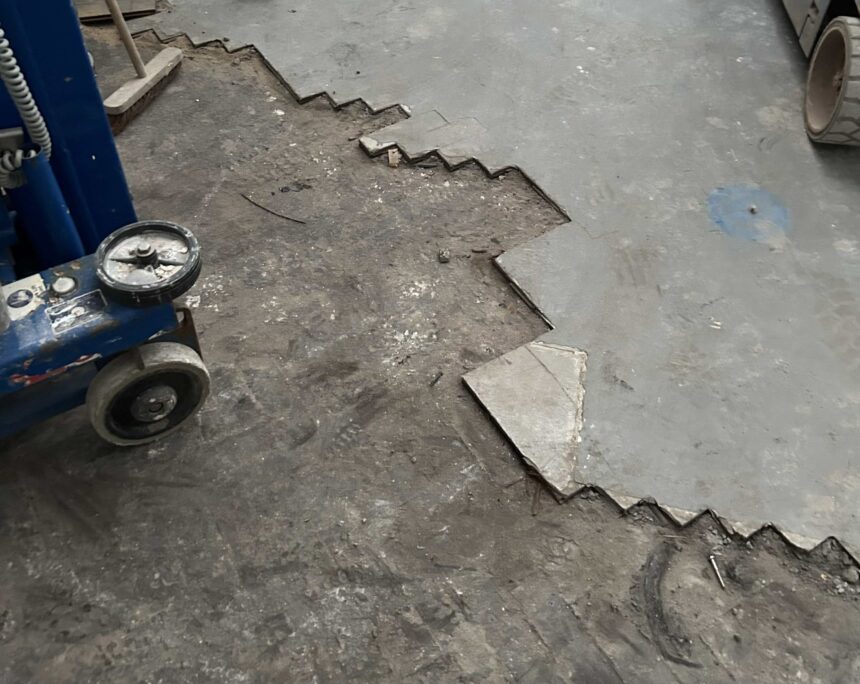
The existing floor was a mix of painted concrete and wood blocks over a concrete base.
Indicative moisture checks conducted with a Tramex meter gave readings of 5.0% across all areas. Any figure above 4.0% is classed as ‘at risk’. The building is of an age where an effective structural damp-proof membrane is unlikely to be present, exposing the subfloor to rising moisture from the ground.
Recommendations
Based on the inspection, we recommended the following course of action.
The first thing to do would be to remove all of the wood blocks, adhesive residues and any contaminants to leave a sound, clean, and micro-textured surface.
It was advised that a single coat of Stopgap F77 solvent-free epoxy damp proof membrane was then applied to control moisture levels using a 1.5mm x 5mm V-notched trowel. A roller, pre-coated with the product, must then be used to achieve a continuous, pinhole-free finish.
Final steps
Once the waterproof surface membrane has cured, it should be primed with Stopgap P141 primer and allowed to dry before applying a minimum 5mm layer of Stopgap 300 heavy-duty smoothing compound. The product can be used as a standalone wearing surface where floorcoverings are not required, making it perfect for upgrading and renovating new and existing floors in a wide range of heavy-duty industrial applications, including factories, warehouses and workshops where forklift trucks are in operation.
Contractors could then apply a suitable sealer according to the manufacturer’s instructions to protect the surface from water and other fluids that it may come into contact with.
Potential extra requirements
The application of a waterproof surface membrane requires a reasonably smooth and flat surface to ensure a continuous barrier without necessitating extra quantity of the product and prolonging drying times. It was therefore recommended that any significant irregularities be addressed prior to its application.
This could be achieved by applying a minimum 3mm skim of Stopgap 1200 smoothing compound, after priming with F. Ball’s Stopgap P131 primer, diluted with seven parts water, and allowing the primer to dry. Stopgap 1200 is moisture resistant, meaning it can be applied before a moisture management solution without being affected by excess subfloor moisture. Patch repairs could also be conducted using either Stopgap 1200 or F. Ball’s Stopgap 460 rapid-setting repair mortar for external floors.
Steve Lane is F. Ball technical representative for the East Midlands.
F. Ball’s regional technical representatives provide advice to flooring contractors on how to get the most out of F. Ball products, including conducting site visits and producing case-specific reports advising on the best course of action for particular flooring projects. Find out who your technical representative is here.