


Sticky Situations
In Sticky Situations, F. Ball technical representatives provide solutions to tricky flooring conundrums they encounter on site visits. In this issue, Steve Lane talks through preparing subfloors in an old chapel as part of its conversion into a food retail outlet.
We were recently asked to take subfloor moisture readings and advise on subfloor preparation ahead of the installation of resilient floorcoverings on the ground floor of an old chapel building that was being repurposed as a takeaway pizza shop.
Assessment
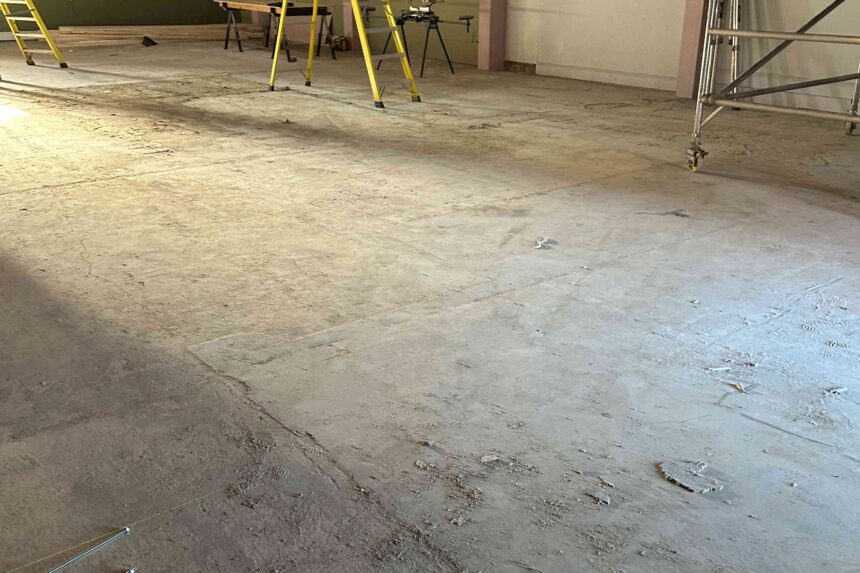
The building had been unoccupied for around five years, and old floorcoverings have been removed from the roughly 200m² area, leaving old smoothing compound together with sections of foam backing from carpet. The subfloor, a concrete screed, was generally in a poor condition. Although it appeared there was a damp-proof membrane (DPM) in the base, apparently it wasn’t functional because moisture checks showed high levels of excess subfloor moisture. BS 8203 (Code of practice for installation of resilient floor coverings) states that if subfloor moisture levels exceed 75% relative humidity, a waterproof surface membrane will be required to protect the installation and avoid the possibility of floor failure.
Recommendations
Based on the high moisture readings and the poor condition of the base, we recommended the following steps to create a smooth surface for the receipt of floorcoverings and eliminate the chance of floor failure arising from excess subfloor moisture.
Firstly, the subfloor should be mechanically prepared to remove old smoothing compound, carpet backing and any other contamination, followed by a thorough vacuuming to leave a sound, clean, dust-free, micro-textured surface.
Patch repairs would be required to fill voids or divots. They first should be raked out and vacuumed to remove dust and debris. The surface must be dampened, filled with Stopgap 460 rapid repair mortar, and allowed to dry.
Next steps
The contractor should then prime the base with Stopgap P131 primer, diluted with seven parts water to one part primer, before applying a minimum 3mm thickness of Stopgap 1200 floor smoothing underlayment and allowing it to dry for at least 24 hours.
This step will avoid applying a waterproof surface membrane directly to the rough screed and it pooling in undulations on the surface, necessitating a greater quantity of product to achieve full coverage, as well as an extended curing period. Using moisture tolerant repair and smoothing compounds (Stopgap 460 and Stopgap 1200) prior to the application of the waterproof surface membrane is essential in these situations.
Contractors then applied a coat of F. Ball’s Stopgap F77 waterproof surface membrane using a 1.5mm x 5mm V-notched trowel and then rolled with a roller coated in the product to achieve a continuous, pinhole-free finish, and then allow it to cure.
Once the waterproof surface membrane had cured, it could be primed with Stopgap P141 primer and allowed to dry before applying another minimum 3mm-thickness of Stopgap 1200 to create a perfectly smooth base for the receipt of floorcoverings.
Adhesive selection
Finally, the installation of chosen vinyl floorcoverings should proceed according to the manufacturer’s instructions, using an appropriate Styccobond adhesive as listed in F. Ball’s Recommended Adhesives Guide (RAG®).
Steve Lane is F. Ball technical representative for the East Midlands.
F. Ball’s regional technical representatives provide advice to flooring contractors on how to get the most out of F. Ball products, including conducting site visits and producing case-specific reports advising on the best course of action for particular flooring projects. Find out who your technical representative is here.