

Tech Talk: Priming
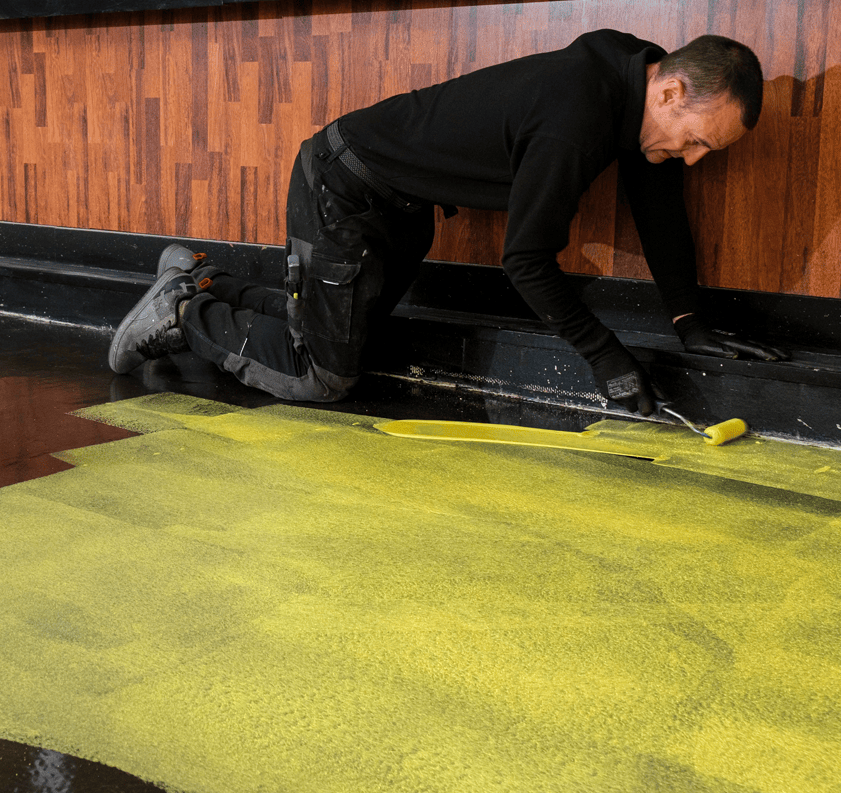
In nearly all cases, subfloors should be primed before the application of an adhesive or a smoothing compound, unless working with flooring preparation products that are specifically formulated to not require the use of a primer. While it is sometimes thought of as unnecessarily costly or time-consuming, priming subfloors can be the difference between a successful flooring installation and complete floor failure. The reasons for this depend on the type of subfloor.
Prime reasons
When applied to non-absorbent surfaces, such as epoxy waterproof surface membranes, terrazzo or ceramic tiles, primers are designed to promote adhesion of subsequently applied smoothing compounds.
Priming absorbent subfloors, including porous concrete and sand/cement screeds, also increases the bond of subsequently applied flooring preparation products, as well as preventing the unacceptably rapid drying of smoothing compounds and adhesives. Insufficient water for complete hydration of a smoothing compound may result in poor build up of strength. Avoiding the rapid loss of water from a smoothing compound will also prolong its open time. Similarly, adhesives that dry too quickly can lose their receptiveness to adhere floorcoverings properly.
Primers can also prevent the incidence of surface defects, such as ‘pinholing’, caused by tiny bubbles resulting from the slow escape of air from the subfloor, which burst on reaching the surface, leaving small pinholes or craters as the smoothing compound cures.
How to choose
The type of subfloor will also determine the optimum primer for a particular situation. General-purpose primers are available that can be used over both absorbent and non-absorbent surfaces. If preparing a particularly absorbent subfloor, such as screeds that include underfloor heating where it has been utilised in the drying of the base, it may be necessary for a contractor to apply a second, or even third, coat of the primer. The contractor would normally use a roller for application to ensure even coverage of the primer, with pigmented primers making this easier to gauge visually.
For non-absorbent surfaces, specialist primers are available that are designed to create a textured finish and enhance bond performance between subfloor and smoothing compound. This extra adhesion is particularly desirable where deep base smoothing compounds are applied at a thickness greater than 20mm; the strong bond created when using a primer such as F. Ball and Co. Ltd.’s Stopgap P141, is better able to withstand the increased stress that thicker smoothing compounds experience when drying.
Primers are also available for specialist applications, such as when working with calcium sulphate screeds, an increasingly popular choice in new builds. These are specially formulated to promote the application characteristics of compatible smoothing compounds; such primers contain finer particles than other commercial primers, helping them to absorb into the surface of calcium sulphate screeds, which are denser than concrete or sand/cement screeds.
Mind the gap
When contractors are working over raised-access panels, the direct application of a smoothing compound to the substrate may result in weak points, where the smoothing compound sinks into the channels at the joints between panels.
For these situations, cement-based primers are available, such as F. Ball’s Stopgap Fill and Prime, which fill the joints between the panels whilst simultaneously priming the subfloor, saving valuable time. These primers have a thixotropic consistency, meaning that they flow freely when stirred but set to a gel-like consistency on standing, enabling the joints to remain filled. They are also suitable for use over substrates with well-bonded, waterproof adhesive residues prior to the application of a smoothing compound.
Stopgap Fill and Prime can also be applied to flooring grade chipboard prior to the application of a recommended smoothing compound, removing the need to overboard the subfloor with plywood, saving valuable time and expense.
When not to prime
Notable exceptions to the requirement to prime include when working with smoothing compounds that are designed to be applied directly over well-bonded old adhesive residues, such as F. Ball’s Stopgap 1500. When used in this way, the subfloor does not require priming. The product can also be applied directly over waterproof surface membranes within 24 hours of the waterproof surface membrane whilst still receptive, before fully cured.
There is also no need to prime certain water-based waterproof surface membranes, including F. Ball’s Stopgap F78, prior to the application of a smoothing compound, or before using a reactive (two-part) adhesive to adhere floorcoverings directly to a substrate.