

Tech talk: Exterior Flooring Installations
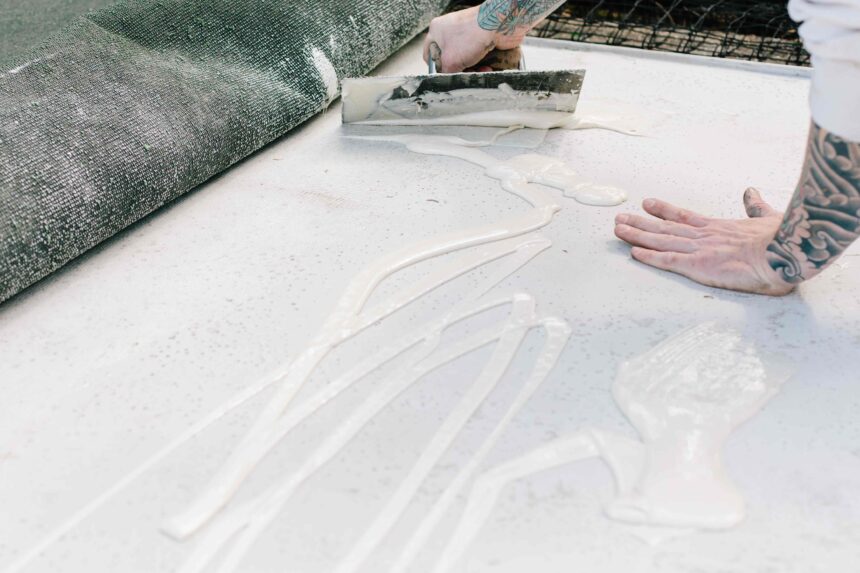
Achieving perfect exterior flooring installations and selecting the optimum products at each stage along the way.
The steps to achieving a professional flooring finish outdoors, as well as in transitional areas such as entranceways, are much the same as when working indoors. The main differences are that the products used must be formulated for outdoor use and external projects frequently involve floorcoverings that aren’t typically installed indoors, such as artificial grass.
When undertaking exterior flooring installations, contractors still need to create a suitably smooth and stable base on which to install the floorcoverings, as they would for an interior installation. Priming the subfloor beforehand is just as important. The flooring contractor can then proceed to install chosen floorcoverings. In each case, the contractor needs to use products that are designed for outdoor use.
Exterior smoothing compounds
External flooring installations typically involve working over concrete or sand/cement screeds. It’s also possible that the screed will be uneven or damaged, particularly if the project is a refurbishment. In most cases, a smoothing compound will be required to create a surface that is smooth and level for floorcoverings to be installed. The smoothing compound must be weatherproof and able to withstand extremes of temperature.
For example, F. Ball’s Stopgap 850 is purpose-designed for external application. It is suitable for smoothing and smoothing screeds, including those that have become worn, impact damaged or weathered and can be used for patios, walkways, and balconies. Its resistance to water once fully cured also makes it ideal for use in locations such as garages.
If desired, the smoothing compound can be used as a stand-alone exterior wear coat, for example, over a garage floor, and is also suitable for the installation of artificial grass or for use with vinyl or matting in transitional areas, such as entranceways. It can be applied in thicknesses between 5mm and 15mm, and, when fully cured, it is resistant to frost and rain.
Mixed with aggregate, Stopgap 850 can be filled up to 50mm for use where concrete or sand/cement screeds are particularly damaged or worn. Alternatively, contractors may opt for a ready-to-use repair mortar that is suitable for exterior floors to repair areas of damage, such as F. Ball’s Stopgap 460 Exterior Repair, before applying the smoothing compound.
As always, it’s essential to prime the subfloor before the application of a smoothing compound. Priming absorbent subfloors of concrete or sand/cement screeds helps to promote adhesion and prevents the unacceptably rapid drying of subsequently applied smoothing compounds.
Adhesives for external use
When using suitably water-resistant products, contractors can proceed straight to installing floorcoverings once the smoothing compound is fully cured. Again, it’s essential to choose an adhesive suitable for outside use.
Epoxy or polyurethane-based adhesives are the traditional choices for installing floorcoverings in outside areas. Such adhesives are tolerant of water, frost and snow.
The latest advancements in adhesives technology have enabled F. Ball to create a one-part, moisture-curing adhesive for internal and external heavy-duty applications: Styccobond F73 PLUS.
The adhesive has been specially developed to provide the high bond strength required to hold a wide range of floorcoverings in place in the most demanding environments, such as in areas subject to surface water, heavy loads and high foot traffic, including in transition areas and entranceways. The adhesive offers high initial grab, and fibres in the adhesive limit early lateral movement, an advantage when installing LVTs.
Styccobond F73 PLUS is also easier to apply and faster curing than traditional alternatives, requiring as little as 90 minutes to secure floorcoverings. The adhesive can be trowel-applied to a wide variety of sound, smooth subfloors, including concrete and sand/cement screeds. Its fast-setting properties allow welding of sheet floorcoverings to take place from as little as two hours.
Checking floorcovering compatibility
It’s always advisable to check the compatibility of particular floorcoverings and adhesives. To do this, flooring contractors can consult F. Ball’s industry-leading Recommended Adhesives Guide (RAG®), which lists adhesives recommended for use with over 6,000 floorcoverings, produced by over 200 manufacturers. A continually updated version of the guide is available on the F. Ball website and as a free app. Alternatively, F. Ball’s technical service department is on hand Monday to Friday, 8.30am–5.00pm, to answer your questions about F. Ball products and how to use them. Contractors can also consult floorcovering manufacturers for advice.